
Imagine a solution for faster genome sequencing. With no prior expertise in genome sequencing we build the case for which exact market(s)/industry(ies) to go after with this solution, exploring both the traditional and new applications/markets for this technology.
• Assumptions: The genome sequencing solution offers the same quality as before at a significantly faster rate (100x) than existing solutions, but 10x the cost. Also, it requires a dedicated facility for doing the actual sequencing (a facility that can be offered as a service or managed by the customer).
We consider:
o The range of markets/applications/use cases for genome sequencing
o What is the estimated global Total Addressable Market size for each application/use case? (including the assumptions made in getting this rough TAM)
o Examples of actual potential customers
o What is the high-level difference between how genome sequencing is used in each market/application/use case?
o Any unique things that a product/solution for this market/application/use case would need to address?
o What are the traditional go-to-market paths for each market/application/use case (direct to customer, VARs, resellers, etc.) and any unique challenges to take into account.
o What are some recommendations? Which markets/industries/applications should the we go after?
The range of markets/applications/use cases for genome sequencing
The Human Genome Project started a large number of initiatives in charting the Human Genome, with the breakthrough disruption by Celera Corporation founded by Craig Venter. The time may be right for yet another such disruption in genomics by offering Quantum Computing driven acceleration in genomics analytics. This memo aims to clarify the reasoning behind this hypothesis by considering several perspectives to inform our team before deciding to pursue such a disruption.
“Advances in Omics technologies have resulted in an explosion of data that expands at an exponential rate…Lab system builds are creating confusion about the path forward for scaling genomics and other omics applications. By 2023, 40% of top 25 healthcare and life science companies will have an enterprise strategy for genomics technology and actively leveraging this for new products and therapies. By 2025, 50% of patients will be diagnosed and treated with aid from genomics, compared to 1.5% from 2013.
Categories of Genomics Business Model Innovations:
1 Comprehensive consumer genomics tests and genome data banks
(23 & Me – Consumer reporting on genetic predispositions and health impact analysis
2 Individual health planning including genomics
(Genetic Health Planning – Predictive health and diet conditions using genetic variations to calculate genomics predisposition )
3 Services based on comprehensive genomic tests
(Genetrainer – personalized training plans, exercises and fitness advice using genomic data
4 Medical precision tests for consumers
(Myriad Genetics – Genetic testing to screen and diagnose inherited predisposition to genetic diseases)
5 Restricted trait tests
(Genecodebook Oy – Personalized disease-causing gene variant testing and detection)”
(Gartner Pub G000722149)
There are several Omics disciplines, each with use cases arising from the genomics field (Wikipedia):
1 Genomics
11 Metagenomics & Culturomics
Global Total Addressable Market (TAM) size for each application/use case with assumptions
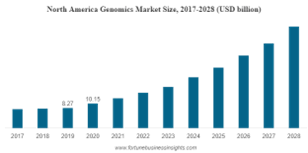
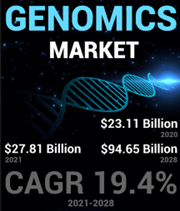
There is a burgeoning market for genomics applications and use cases. For the US, the market is projected to grow from 2020 at ~$10B to 2030 at ~$40B across all market segments. The total global market may be from 2020 at ~$23.11B to 2030 at ~$94.65B depending on various rates of change in the levers applicable to the business dynamics for each region in the market. The emergence of pandemics may also hasten the growth rates for this market.
The common thread across all these is the need to increase speed to analyze genomic datasets. The volume of this data is exponentially increasing, driven by complete gene assays being done at a cheaper and faster rate using various approaches leveraging High Performance Computing in cloud platforms. (eg: AWS, Azure, GCP, IBM, NVidia). Cloud driven Classical HPC may serve as good architecture to pipe to Cloud-Quantum Hybridization (eg: Dell-IonQ Hybrid HPC-Quantum).
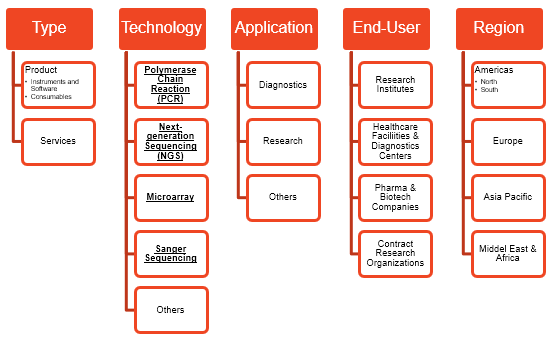
The TAM is driven by Market Segmentation dimensions with hierarchies as follows (Summarized from here) :
Potential Customers
Three industry segments across market segments are potential target customer bases:
Life Sciences
(eg: Illumina, Guardant Health, 10X Genomics, Roche, Abbott Molecular, Abbott Corelabs)
Healthcare Providers
(eg: NHS UK, SNUH, NHGRI)
Healthcare Payers
(eg: UHG Optum, Aetna DNA)
Each segment can potentially be a target for a dedicated hybrid HPC-Cloud-Quantum solution sale including a Dell HPC on-prem classical HPC cluster, source data and CICD DevSecOps pipelines from AWS, Azure or GCP, coupled via cloud provider or direct secure connection into a quantum computing provider’s platform.
A single sale could involve several hundred million up-to a billion USD in addressable revenue stream, deployable with multi-year contracts between the chosen HPC vendor (eg: Dell), cloud platform vendor (eg: AWS, Azure or GCP), professional services vendor (eg: Dell Professional Services or Accenture) and Quantum Genomics product engineering and applications services.
High-level difference between how genome sequencing is used in each market/application/use case
A collaborative brainstorming activity to be hosted by Pivotport, Inc. needs to be conducted. Participants invited to this session will need to conduct a detailed review of the linked technologies and key differences to consider impact to solution design. Please send email to Rajiv@Pivotport.com if you are interested in participating in this online activity.
Unique needs for solution to address applications/use cases
Depending on the potential customer, the technology chosen for genomic assays may vary. Matching this choice to the hybrid HPC-Cloud-Quantum solution will require:
- Strategy scenario simulations to select best strategy using System Dynamics and Strategy Dynamics modeling.
- Business case creation for customer board room approval.
- TCO/ROI derived from the chosen system dynamics model.
- Architecture for proof-of-concept, pilot and production solution.
- Program management office for staffing organization, execution planning and controls.
- Center for Excellence in HPC-Cloud-Quantum for innovation processes and knowledge transfer.
All of these can be using partner-collaboration driven professional consulting services to help the customer determine the feasibility of such an endeavor.
Go To Market paths for each application/use case and unique challenges
There are many challenges in Go To Market paths for each of the use cases depending on the use case being selected from a specific Genomic Business Model Innovation, Market Segment Technology, or Potential Customer type as described in earlier sections. Generally the challenges can be described amongst interdependent factors between these as:
- Easy to solve but difficult to execute.
- Easy to solve but difficult to fund.
- Lack of Quantum Hardware deployability based on the quality of results required.
- Ease of solvability but lack of production scalability.
Some unique challenges in this area are already receiving blogger attention as well. (eg: Quantum Pharma, Quantum Computers Disrupting Healthcare)
Recommendations
To arrive at a go/no-go decision on whether Quantum Genomics Application solutions are feasible, a brainstorming workshop is necessary, involving executives, program management, engineering and software application team leads, sales and marketing leads.
Preparation will involve thorough reading of the linked content in this blog as well as individual research into the viability of quantum applications for faster genomics.
Quantum algorithms applicable to the quantum solution aspects can also be reviewed and quantum computing hardware capabilities in such algorithm execution considered from the roadmap impact standpoint. Current research in Quantum Computing for Genomics must be reviewed, considering the current engineering and applications capabilities quantum computing providers offer, versus what may be needed through additional roles to be hired. (eg: Aritra Sarkar’s thesis on the topic, TU Delft software). There is also some recent research published by Nvidia that is worth considering in terms of how Quantum Neural Networks can benefit training Large Language Networks applied to genomics. LLNs in genomics can have large variables (500M to 2.5B) in the training and supercomputing approaches that require experiments to determine optimal outcome projections using not just the final layer but intermediate layers as well. This would be a really important contribution by QNNs to train LLNs faster using a hybrid cloud HPC plus Quantum Computing approach.
Following an internal “Go” decision, a Go To Market plan with key milestones in a timeline must be established with tight alignment to the planned product roadmap.
Further outreach via NDA-based workshops with potential customers, as well as partners such as Dell for HPC, AWS, Microsoft or GCP for cloud modular services, vendors for professional services and quantum hardware providers (such as IonQ, Quantinuum, Pasqal, IBM and Atom) integration should be scheduled.
A TAM Model for this can be developed using commonly available templates with key financials inserted through collaborative activities with subject matter experts in genomics infrastructure development and financing.
Enabling faster genome sequencing with quantum applications will involve many aspects of the Value Streams in a Disciplined Agile Process, such as this one by Project Management Institute.
TAM Models
The below examples are a start of TAM modeling for Quantum Genomics solutions. These can be used in collaborative activities to iterate and develop further.
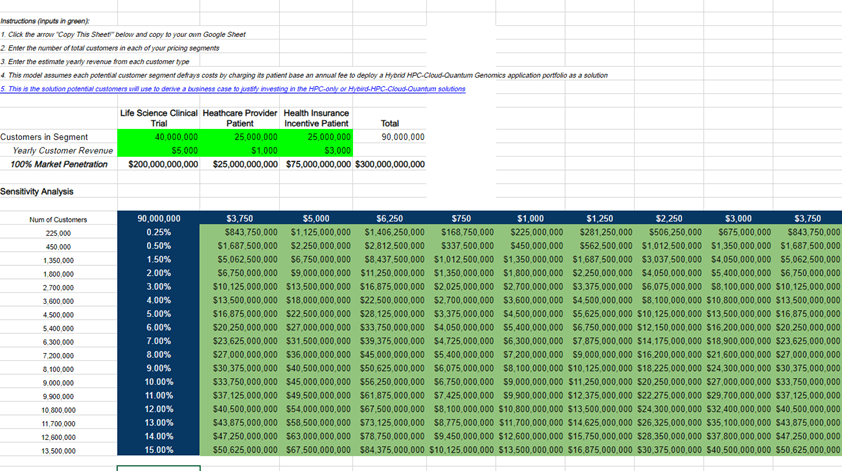
Figure 1 TAM Sensitivity Analysis: Consumer Model for use as Business Case by Potential Client
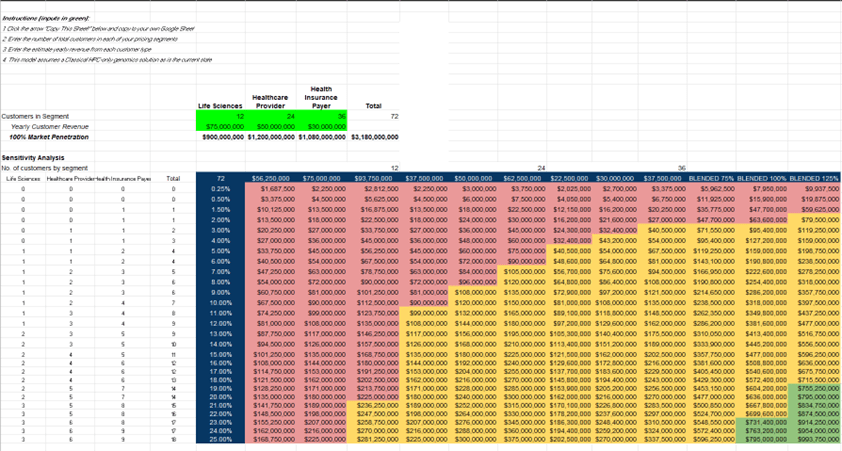
Figure 2 TAM Sensitivity Analysis: Classical HPC-Only Model
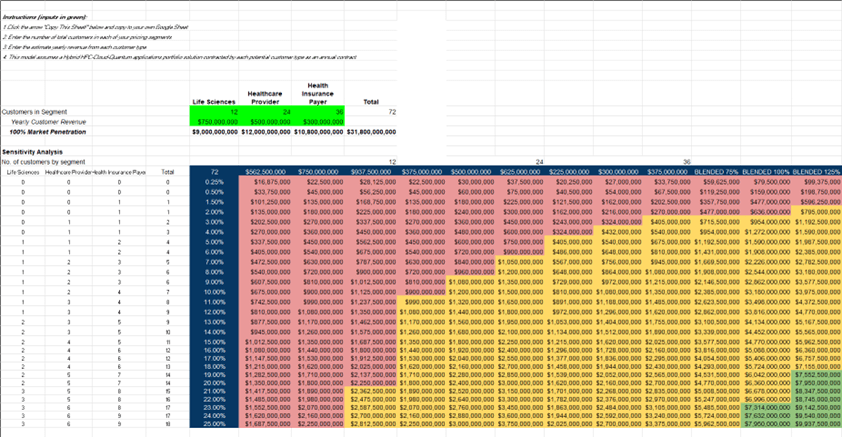
Figure 3 TAM Sensitivity Analysis: Hybrid HPC-Cloud-Quantum Model
Stay tuned for more as we develop this concept!

You must be logged in to post a comment.